

The play follows an elite club of Etonians as they get wasted in (and then proceed to lay waste to) a small family pub. It is a direct satire on the infamous ‘Bullingdon Club’, of which, as the programme reminds us, Boris Johnson was once a member. This production doesn’t shy from direct political messaging - our current prime minister is not only name-dropped, but also imitated by the cast. Tom Gill’s Alistair Ryle makes mention of a ‘prozzerrrrr’, his pronunciation unavoidably calling to mind Johnson’s attempts at saying ‘frisbeee’, or ‘veegan’. Even if these pronunciations (and some cast members’ Johnsonian habit of slapping the table to hammer home a point) weren’t intended as direct takes on the PM, this play still provides a withering indictment of the privilege of the current ruling class.
This is a difficult play to stage, with such a large cast of even larger personalities all interacting with each other during extended dinner-table scenes. It had the potential to look too chaotic too quickly - but not in this production. The cast worked all together as one roaring beast when roaring was required, slamming tables in unison and moving as one unit, which helped to tell a visual story about this club as a collective.
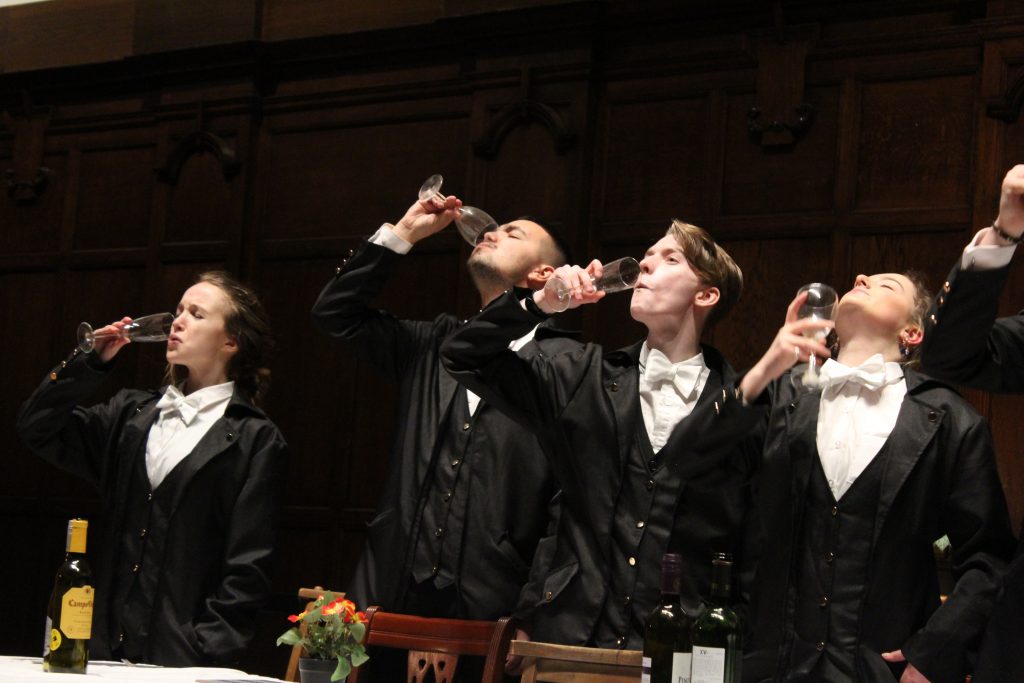
That’s not to say that nobody stood out; quite the opposite. Every cast member had their own moments to take over a scene, and each fully exploited those moments. From Patrick Thompson’s Jeremy, the veteran of the club who talked with tangible excitement at the start about his memories of the Riot Club, wiggling and jerking like a British Mr Burns in his bowler hat, to the boisterous confidence of Harry Villers (Conor Love), whose controlled manipulations at the start of the play were convincing enough that his vulnerably emotional moments later in the play hit with startling force; this cast made a pretty unlikeable bunch of characters unique and compelling.
Hugo was played gloriously by Martha Watson, who fully leaned into the self-confident mannerisms of an Etonian, but her occasional looks of indignance, her quick reprimands of other characters, demonstrated Hugo’s greater sense of morality than the others. Callum Ismail strutted around as Dimitri, resting his arms on the furniture and generally posing like he owned the place. Of all the characters, he looked most at home in this environment, which only made the discrimination he (Dimitri) faced for his Greek heritage all the more outrageous. Lewis Watson’s slightly heartbreaking portrayal of the bullied Miles, Ricky Pancholi’s drunken staggering and giggling as Toby, and Tim Daft’s sycophantic chortling as Ed, all combined into a display greater than the sum of its parts.
Among all that, Tom Gill still dominated scenes as Alistair Ryle. His enjoyment of the lead character was clear in the delivery of every line; he put his full body and face into an impersonation of the pub owner Chris, he played with a sword during other people’s dialogue, and his monologues on the decline of the country felt so real they actually provoked sympathy for this clearly misled character. Gill delivered every line with relish, and with more than a whiff of magnificence.
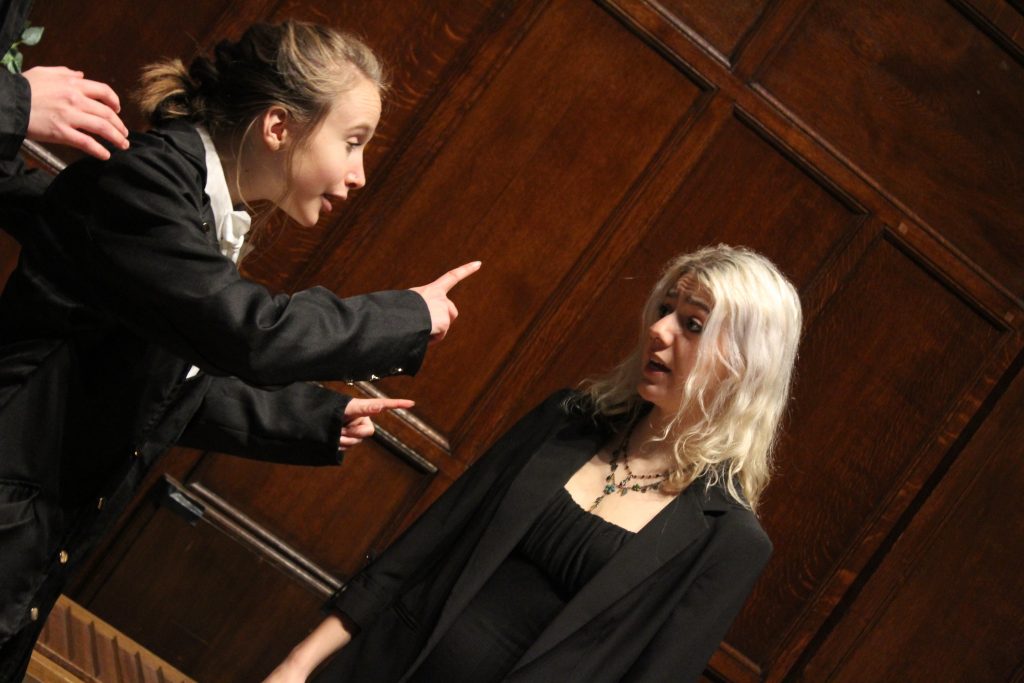
Now, you may have noticed a lack of something in that list of character names: where are the women?
This is a play about the excesses of a privileged male elite, and as such doesn’t leave much room for female characters. Those who do interact with the Riot Club become a part of the destruction it leaves in its wake - and it is this destructive aspect of the club’s lifestyle that was highlighted so well by the performances of Tilda Billsberry-Grass (Rachel) and Grace Parry (Charlie), as well as by what happens to Chris (played by Alex Hearne-Potton).
Rachel is played as an excellent counterweight to the arrogant club members, her interjections and witticisms in the first half played so confidently as to make her later exasperation, her flinches and cries, even more poignant. Her last line turned an already powerful scene into an unforgettably tragic moment.
An intense play all round, with rarely a dull moment, this production directed by Emily Hope and Lauren Li filled the fittingly grandiose space of King’s Hall with ease, and more than lived up to the name of the club it depicted. Truly a riot.
★★★★