

In Transcendence, a 2014 sci-fi thriller film in which a brilliant scientist played by a pre-defamation trial Jonny Depp uploads his consciousness into a quantum computer in a bid to save himself from certain death but instead becomes a quantum superintelligence capable of remotely controlling people’s minds.
Scientists are probably not working on a transhuman quantum mind control device... yet. But quantum computing research is on track to revolutionise how governments and industries can tackle complex problems that would take classical computers thousands of years to solve accurately.
Now, I’d like to imagine a pink frosted donut.

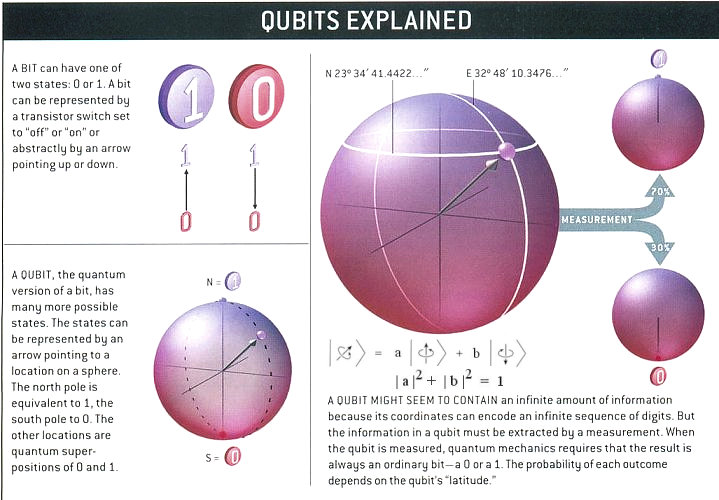
Classical computers rely on binary digits (bits) that can be in one of two states - 0 or 1.
Now think of that same donut spinning vertically in space.
When it is spinning, it is neither frosted side or plain side, but a combination of both 0 and 1. Quantum computers use make use of the weird qualities of sub-atomic particles. They can be 1, they can be 0, but also a quantum superposition of both 0 and 1.
Quantum computers leverage these qubits that can exist in multiple states simultaneously. By having access to a greater number of possible states, a quantum computer can perform calculations much more efficiently than a classical computer.
In October 2019, Google controversially announced that it had achieved ‘quantum supremacy’ with its 53 qubit ‘Sycamore’ processor solving a problem in 200 seconds that they claim would have taken even the most powerful supercomputers 10,000 years to solve.
While the work by Google sounds impressive, one of the main criticisms of quantum computing is that it is still largely a theoretical concept, and there are significant challenges to developing practical, large-scale quantum computers. Current quantum computers have a limited number of qubits and are susceptible to errors, which makes it difficult to scale them up to perform more complex computations.
Researchers at Sussex University recently made a breakthrough in the development of quantum computers, enabling them to transfer quantum information between computer chips at record speeds and with 99.999993% accuracy. Professor Winfried Hensinger who led the research, “In demonstrating that we can connect two quantum computing chips - a bit like a jigsaw puzzle - and, crucially, that it works so well, we unlock the potential to scale up by connecting hundreds or even thousands of quantum computing microchips.”
A classical computer would take 300 trillion years... to crack RSA encryption
These capabilities could spell danger for many forms of cryptography designed to keep everything from nuclear weapons right through to the encryption that keeps your bank account secure.
In theory, a quantum computer could quickly factor large numbers, which is the basis of many encryption algorithms. A conventional computer would take around 300 trillion years – 22,000 times the age of the universe – to crack the ubiquitous 2,048-bit RSA encryption. But a quantum computer could take just 10 seconds, using Shor’s Algorithm, which is designed to find the prime factors of an integer used in encryption keys.
To construct a quantum computer capable of breaking RSA, it would be necessary to employ several million, if not billions, of qubits. However, only a fraction of these qubits (known as logical qubits) would be utilized for computation, while the rest would be devoted to error correction and compensating for the detrimental effects of decoherence (that's interference from background .
Further advances in error correction and scalable quantum computing are promised by IBM this year with the company set to unveil its Heron processor which will feature only 133 qubits. Although it may appear to be a regression in terms of processing power, the company asserts that Heron's qubits will be of the utmost quality. The new chip will be able to directly link up with other Heron processors, signalling a shift from standalone quantum computing chips to "modular" quantum computers that consist of multiple processors connected together.
With quantum computing, we could learn how to turn nitrogen into fertiliser, feed the world and significantly reduce CO2 levels.
Quantum computers also have the potential to simulate the behaviour of complex molecules and materials, opening new opportunities in drug discovery and materials science.
According to the International Energy Agency (IEA), the chemical industry as a whole (which includes the production of fertilizers as well as other chemical products) accounted for 13% of global energy consumption in 2019. Of this, about 1% is estimated to be used specifically to produce fertilizers. Without fertilizers, nature struggles to replenish the nutrients in the soil necessary for growing and harvesting. If this process could be simulated with quantum computing, we could learn how to turn nitrogen into fertiliser, feed the world and significantly reduce CO2 levels.
In 2021, Boris Johnson promised the UK would “go big on quantum computing” by building a general-purpose quantum computer, and secure 50% of the global quantum computing market by 2040.
While we can all take what the former PM says with more than a pinch of salt, the government is set to announce its long-awaited "Plan for Quantum" in the Spring Budget, promising a 10-year research and innovation programme.