

From what initially began as planning a little visit to Ljubljana with an excursion to the lake, our getaway grew from an adventure of seeing sights we could only dream of in the Slovenian countryside- as well as a subsequent trip to Venice, driven by a Hungarian man in a white minivan. But that’s a story for another time.
Personally, one of the highlights of my trip was visiting the Postojna Caves in the sleepy town of Postojna, Slovenia. During our 3-day stay in the pristine, stunning capital of Slovenia, we had planned Lake Bled as our only day trip, since getting to and from the northwestern lake would eat into a full day of our travels and we wanted to explore Ljubljana just as much, instead of using the city as a springboard to other places. However, with Ljubljana being so little, we bit the bullet and bought tickets to go and visit the world-renowned cave system... and I am unbelievably grateful we did.
Tickets from Ljubljana Central Station to Postojna Caves were about 5 euros each, and the 50 minute bus journey took us into the mountainous Green Karst region of Slovenia, eventually leading us to Postojna, which sits at an altitude of 2000 feet. At Postojna, you can visit the caves, the vivarium, and the Predjama Castle, a renaissance attraction, for various different packages- you can do all three or just one, or you can mix and match. We visited the caves and the vivarium for a deal of 27 euros.
Postojna Caves is a 90 minute trip. After queueing for the appropriate language guide, you embark on a distinct yellow and red train into the caves, where you descend 377 feet into the caves, which spans 25 kilometers. After a 15 minute slow ride dipping and diving through the limestone structures, pointy and jagged like the teeth of a minotaur, you disembark from the train and follow your guide through a phenomenal, jaw-dropping tour through the enormous cave system.
I never thought I would be in my element as much as I was. Caves petrify me, and so this excursion was a huge step out of my comfort zone- but fast forward 10 minutes into the experience, and I was considering geology as a new career path. The Postojna caves are utterly captivating.
The rocky, limestone sanctuary buried within the mountains has a magnitude that photos cannot capture, and being able to adventure through them was an honour
Despite some graffiti in the caves dating back to the 13th century, the caves were first described by geologist Johann Weikhard von Valvasor in the 17th century. But in 1818, a lamplighter by the name of Luke Culc accidentally discovered more parts of the cave after lighting lamps ahead of a visit from the first emperor of Austria-Hungary. And after Archduke Ferdinand visited the following year, the cave system was opened to the public and hailed a captivating tourist destination- and to date, over 30 million tourists have flocked to the destination.
Our group- including a very chatty man from Cheddar Gorge, lovely to meet you, sir- were weaved in and around the limestone icicles by a fabulous tour guide. He explained the outstanding geography of the place; the cave formations are formed by carbon dioxide being absorbed into rainwater, which then drops through cracks in the limestone and dissolves it.
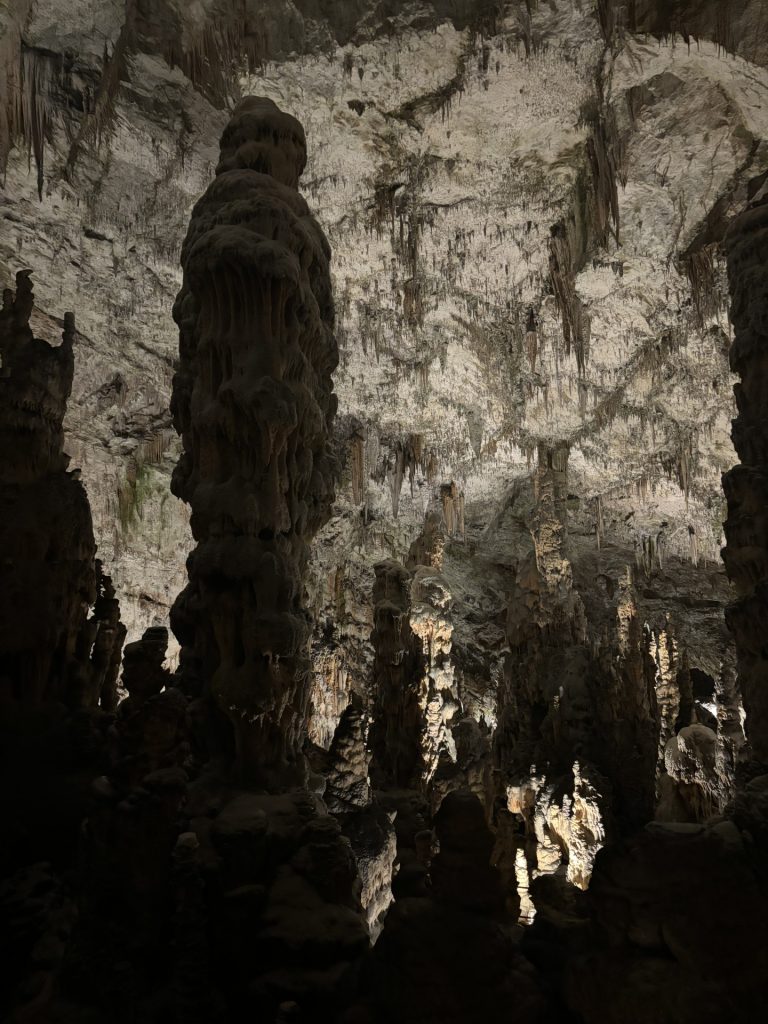
Picture the caves as being like a huge room, with a carpet and a ceiling. The caves’ formations are divided into two types; stalagmites, which grow from the floor and upwards, and stalactites, which hang from the ceiling and grow downwards. Stalagmites are formed by the calcium carbonates in the rainwater, and it takes 100 years for a singular centimetre to form. The stalagmite pictured below is over 160,000 years old!
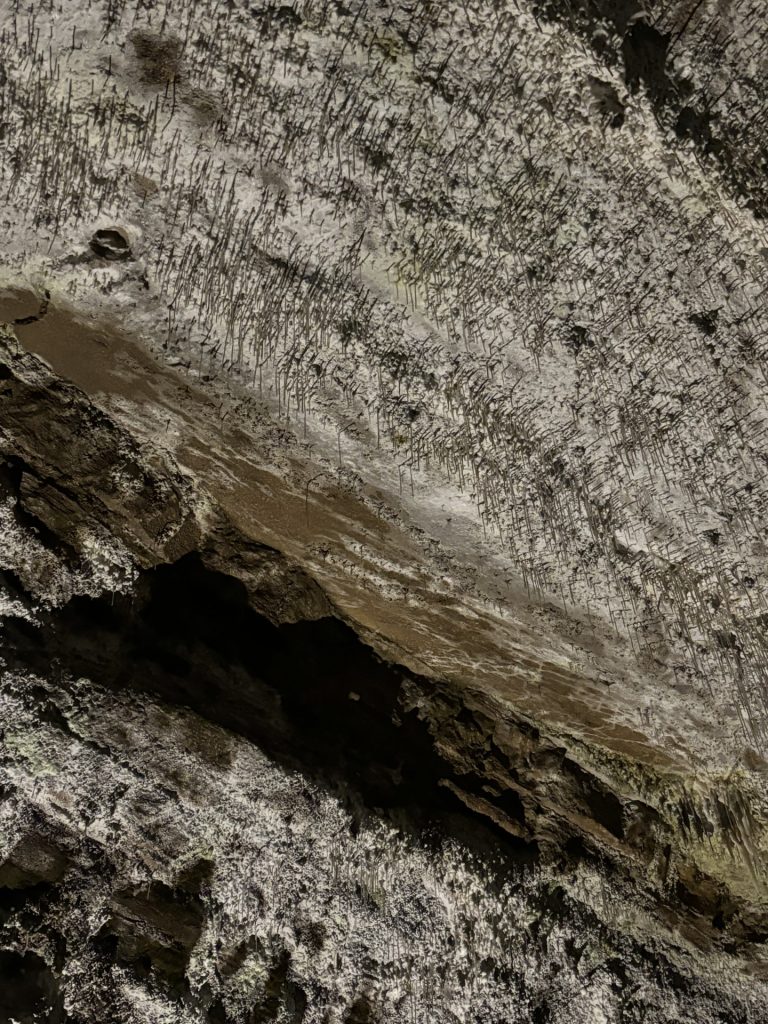
We were also shown an interesting kind of limestone formation, funnily coined the ‘spaghetti formations’. These guys are stalactites in the respect that they grow from the ceiling and downwards, however, unlike the other stalactites, they are hollow. This is because the mineral deposits only form around their edges, rendering them only able to grow from their tips, and only able to grow a single centimetre every 1000 years. These stalactities, pictured below, are microscopic- but are 20,000 years old.
After buying a postcard from the cave’s post office, the only post office in a cave in the world, we (begrudgingly) rose to the surface after another ride on the train. Stopping by into the vivarium, we encountered the ancient salamanders native to the caves, called ‘olms’; an endangered species, the ‘human fish’ salamanders are blind due to having adapted to the dark, wet caves, and are pinkish-white in colour. They can live up to over a century, are completely aquatic amphibians, and in the 17th century, were believed by local people to be mini dragons.
In the vivarium you will also find pieces of graffiti etched into the limestone walls of the caves. Graffiting messages into the caves was hailed as an honour back in the day, whereas now, it is (appropriately) viewed as harmful vandalism- but nonetheless, the moist conditions of the caves have preserved all of the graffiti, and you can see for yourself the scriptions of people who visited in the 1800s.
Despite this graffiti being disheartening, looking at the italic, loopy handwriting from visitors etched over 150 years ago was mind-blowing. I was reading text that was left by people during the Civil War; before the Titanic sank; before the world wars. I felt connected to them in a way.
I’ll never forget mine and Charlotte’s trip to the Postojna Caves and how magnificent they are. The rocky, limestone sanctuary buried within the mountains has a magnitude that photos cannot capture, and being able to adventure through them was an honour. If you're lucky enough to visit the caves, make sure to wrap up warm- the caves are freezing!