

Nexus has built up more than thirty pieces of permanent artwork stretching across stations, concourses and inside the trains themselves. The vast collection ranges from pieces shaped by local communities to work created by internationally recognised artists.
I decided to go on a little side quest to visit some of the artworks displayed on Nexus' website.
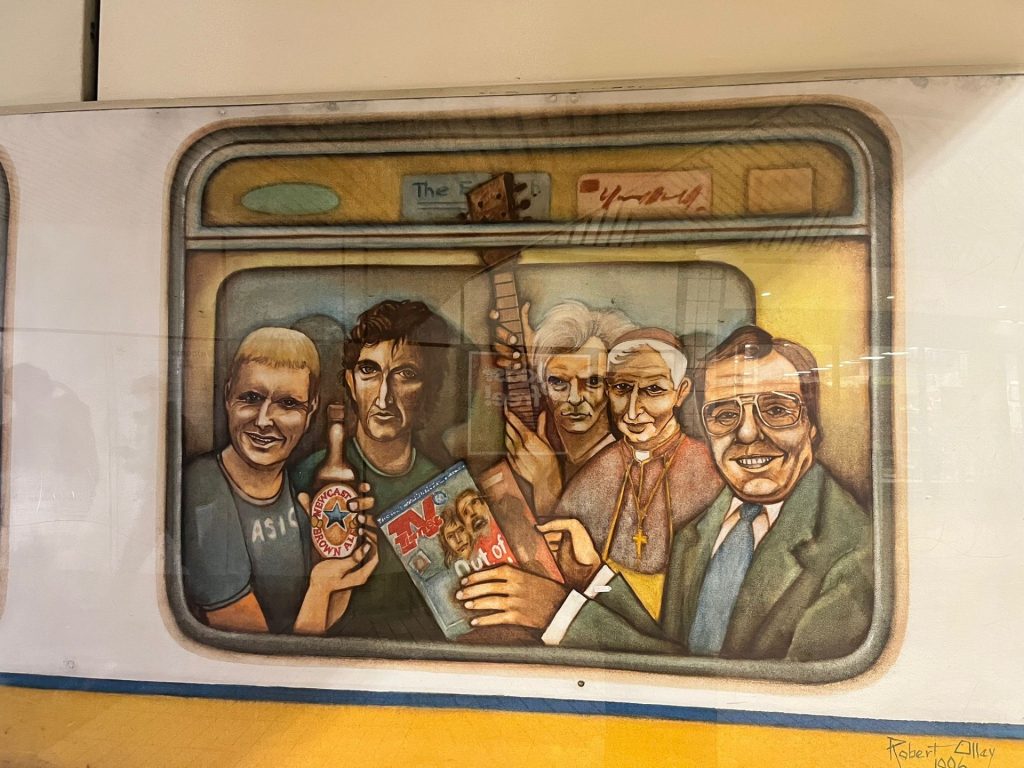
Monument station is perhaps the most layered example. Directly beneath one of the city's most recognisable landmarks, the Blackett Street entrance is watched over by ‘Famous Faces’; a mural by Bob Olley depicting fourteen well-known faces from across the region, including Sting and Rowan Atkinson, peering out of a Metro carriage window. The artwork celebrates the region’s cultural heritage, recognising the people who have shaped its identity while also reflecting the everyday passengers who use the system. By placing these familiar faces at eye level in a busy public space, the piece creates a sense of pride and belonging, reminding commuters that the Metro is an integral part of the North East’s identity.
...connects the station to the region’s industrial heritage...
Less immediately obvious is ‘Parsons Polygon’ just outside on Blackett Street, where artist David Hamilton transformed a functional ventilation shaft into a Tardis-esc ceramic tribute to engineer Sir Charles Parsons. Commissioned by Nexus, its surface is etched with abstract patterns inspired by Parsons’ technical drawings, and is made from the same clay used for Eldon Square’s bricks, turning an engineering form into a piece of decorative art. It is effective because it connects the station to the region’s industrial heritage, transforming an ordinary piece of infrastructure into something meaningful and visually engaging.
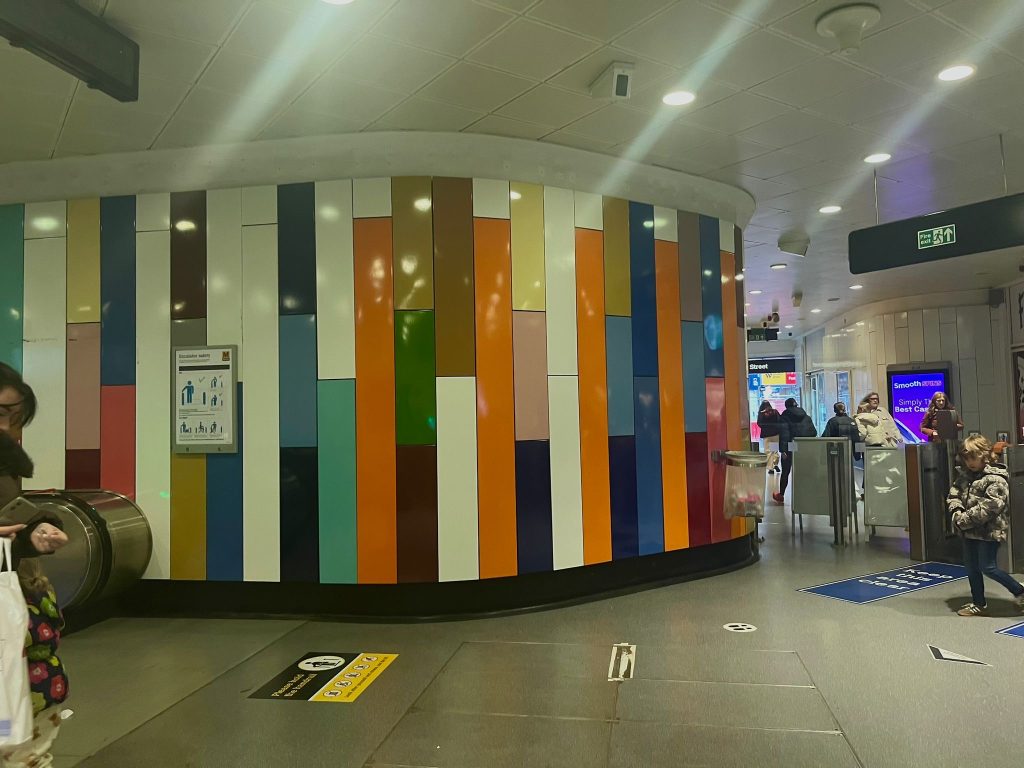
A short ride away at Haymarket, a station very familiar to students at Newcastle University, got a significant artistic rebrand when it was rebuilt and reopened in 2010. Artist Lothar Goetz created ‘Canon’; a vibrant installation of colourful panels that run through the curved platform spaces and stretch up into the concourse. Nexus chose to add increased visual interest to an otherwise functional space, making the station feel more distinctive and less purely utilitarian for the people who pass through it each day.
Byker station has developed perhaps the most sustained relationship with art on the entire network. Since 2005, the station has hosted internationally recognised artists and community photography exhibitions under the ‘Next Stop Byker’ programme.
‘Trails and Treasures’ by Rednile Projects was commissioned in 2013 and is an eleven-metre-wide mural that reflects children’s favourite memories of Byker into a colourful, interactive design. Working with children from the YMCA in Byker, artists took pictures of the children’s favourite things, especially incidental details and elements of Byker’s surroundings, and created patterns with them, placing them all together to create four large circles of images. The design includes embedded QR codes that are buried within the piece to let passengers scan them to reveal the story behind each image.
...reflecting the community it serves...
This has resulted in a piece of artwork that is shaped by local experiences and stories, placed within the daily travel routines of its residents, reflecting the community it serves rather than simply just decoration.
Although my side quest took me to Byker, I unfortunately couldn't find this art piece! (Maybe I didn't look hard enough, or it has been taken down.) I instead had a little wander round, but shortly hopped back on the train once a saw a fight break out on the street...
Perhaps the most significant development in the Metro's artistic history is the art on the actual trains themself. In 2023, Tyne and Wear Metro was the first urban transit system in the world to permanently install contemporary art inside its new fleet trains. Four artists each won a commission to create floor to ceiling works for the interior end walls of the carriages, with each piece appearing 23 times across the 46 new trains.
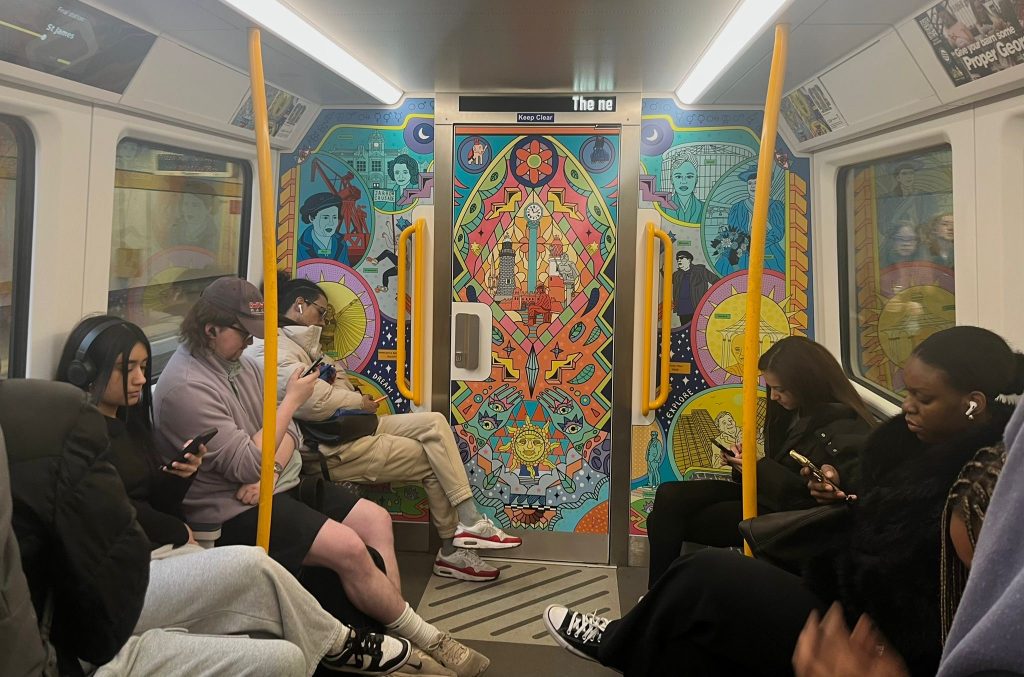
The works are vary in both style and subject; Sofia’s ‘Blazing Trails’ draws on influences including her Punjabi heritage and her upbringing in Newcastle to explore the personalities which make the North East a vibrant place to live.
Bryony’s ‘Macro-Micro’ is a collage made from paper pieces built from images sent in by locals when they had to answer the question “what makes this place glow?”
Hazel’s ‘North Sea Mermaids’ is an empowering digital mural celebrating the community of women who comes together to wild swim in the beaches of Tynemouth, South Shields and Seaburn.
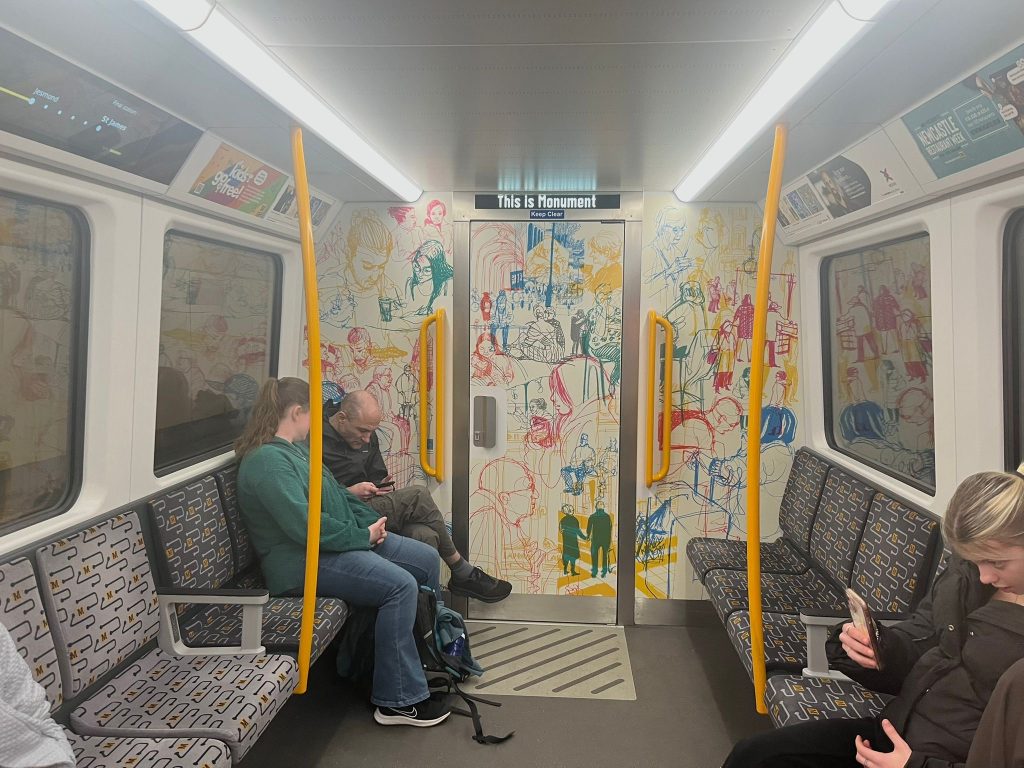
Sara’s ‘Drawn to Life’, depicts enlarged and overlapped sketches of passengers and people around Newcastle which she collected over months of travelling on the Metro.
...art which will inspire, intrigue and entertain millions of Metro customers for years to come.
Together, the four pieces tell what Nexus customer services Director Huw Lewis described as "four very different stories about modern North East England, but between them have created art which will inspire, intrigue and entertain millions of Metro customers for years to come.”
The new metros are quite different to the ones we have all known and loved, with its linear seating and extra standing space, but the most unique aspect of them is this artwork, which successfully represents the diversity of the North East.
The Metro’s collection of artworks shows that art does not have to sit inside a gallery to have value, rather it can live in the spaces we move through every day. Whether it is on the trains themselves, the platforms or the surrounding areas, each piece is a tribute to local history and demonstrates how creative the North East is, although it often goes unnoticed compared to other parts of the country.